Ease of Doing Business Program
Republic Act No. 11032, also known as the Ease of Doing Business and Efficient Government Service Delivery Act of 2018) refers to simplifying and streamlining of government processes and services.
DILG-IS Sub-Cluster 1 implements a comprehensive suite of national programs designed to strengthen local governance, promote transparency, and empower communities across the First Congressional District.

Republic Act No. 11032, also known as the Ease of Doing Business and Efficient Government Service Delivery Act of 2018) refers to simplifying and streamlining of government processes and services.

The Support to Local Governance Program (SLGP) is a comprehensive initiative aimed at strengthening the capacity of local government units (LGUs) to deliver effective, transparent, and accountable public services. By providing technical assistance, capacity-building activities, and financial support, the SLGP helps LGUs implement key governance reforms, improve local infrastructure, and enhance service delivery in areas such as health, education, and disaster risk management. The program also fosters local innovation and community participation, empowering LGUs to address the unique challenges of their areas, driving sustainable development, and contributing to nation-building through improved local governance.

The Seal of Good Local Governance for Barangay (SGLGB) is a performance-based assessment and recognition system managed by the Department of the Interior and Local Government (DILG). It evaluates Philippine barangays on financial stewardship, disaster preparedness, social protection, and public safety to drive grassroots governance excellence.

The Civil Society Organization–People's Participation Partnership Program (CSO-PPPP) is an initiative by the Department of the Interior and Local Government (DILG) through the Bureau of Local Government Supervision. It aims to promote transparent and participative local governance by engaging CSOs in local planning, budgeting, project implementation, and monitoring.

Local Economic Development (LED) is a strategy where local government units (LGUs) partner with communities and businesses to create business-friendly environments, attract investments, generate jobs, and boost sustainable growth in their local jurisdictions.

It is a technology-based system used to collect, process, and validate detailed socioeconomic and demographic data—such as health, income, employment, and access to basic services—at the household and community levels.

The Monitoring and Evaluation of Assistance to Local Government Units (MEALGU) program is a vital initiative aimed at assessing the effectiveness and impact of various government assistance programs provided to local government units (LGUs). Through systematic monitoring and evaluation, MEALGU ensures that resources are utilized efficiently and that the intended outcomes of assistance initiatives are achieved. The program involves collecting and analyzing data to measure progress, identify challenges, and highlight best practices in local governance. By providing valuable insights and feedback, MEALGU enhances accountability and transparency, enabling LGUs to make informed decisions and continuously improve their service delivery for the benefit of their communities.

The Local Roads and Bridges Inventory (LRBI) is an official online database and digital mapping system managed by the Department of the Interior and Local Government (DILG) to record, monitor, and assess the status, type, and physical condition of provincial, city, municipal, and barangay roads and bridges across the Philippines.

Improving Public Trust, Accountability and Anti-Corruption Mechanisms in Local Governments

The 8888 Citizens' Complaint Hotline is a 24/7 national public service mechanism where citizens can report corruption, red tape, and poor frontline service in any government agency or local government unit (LGU).

Department of the Interior and Local Government administers the annual Lupong Tagapamayapa Incentives Awards (LTIA) to honor outstanding barangay justice committees (Lupons) for effectively resolving community disputes. Established under Executive Order No. 394, it grants financial and economic benefits to high-performing Lupons.

Preventing and Countering Violent Extremism (P/CVE) and insurgency requires moving beyond traditional military force. It pairs security-based counter-terrorism with proactive "soft" measures—addressing root economic, political, and social drivers that radicalize and recruit vulnerable populations.

The Philippine Anti-Illegal Drugs Strategy (PADS) is the national blueprint of the Philippines to address and counter the illegal drug problem. Institutionalized via Executive Order No. 66 in 2018 and led by the Dangerous Drugs Board (DDB), PADS mobilizes a whole-of-nation and balanced approach spanning law enforcement, community awareness, and health-based interventions.

It refers to a mandatory planning and budgeting framework designed to promote gender equality, eliminate institutional biases, and empower women, men, and LGBTQ+ persons across all local government units (LGUs).

It is a mandatory, annual performance-based assessment in the Philippines used to evaluate how well local government units (LGUs)—specifically cities and municipalities—implement programs and deliver services that uphold children's rights and welfare.

The Full Disclosure Policy (FDP) requires Local Government Units (LGUs) to post key financial documents and transactions for public to see, ensuring transparency and accountability in local governance.

The Seal of Good Local Governance (SGLG) is an award, incentive, honor and recognition-based program for all LGUs and is a continuing commitment for LGUs to continually progress and improve their performance.

Self-assessment tool to monitor LGU performance across governance areas.

Monitoring and reporting of anti-illegal drugs programs.

Coordination and monitoring of peace and order programs at the municipal level.

Disaster preparedness, response, and mitigation program coordination.
Results Framework
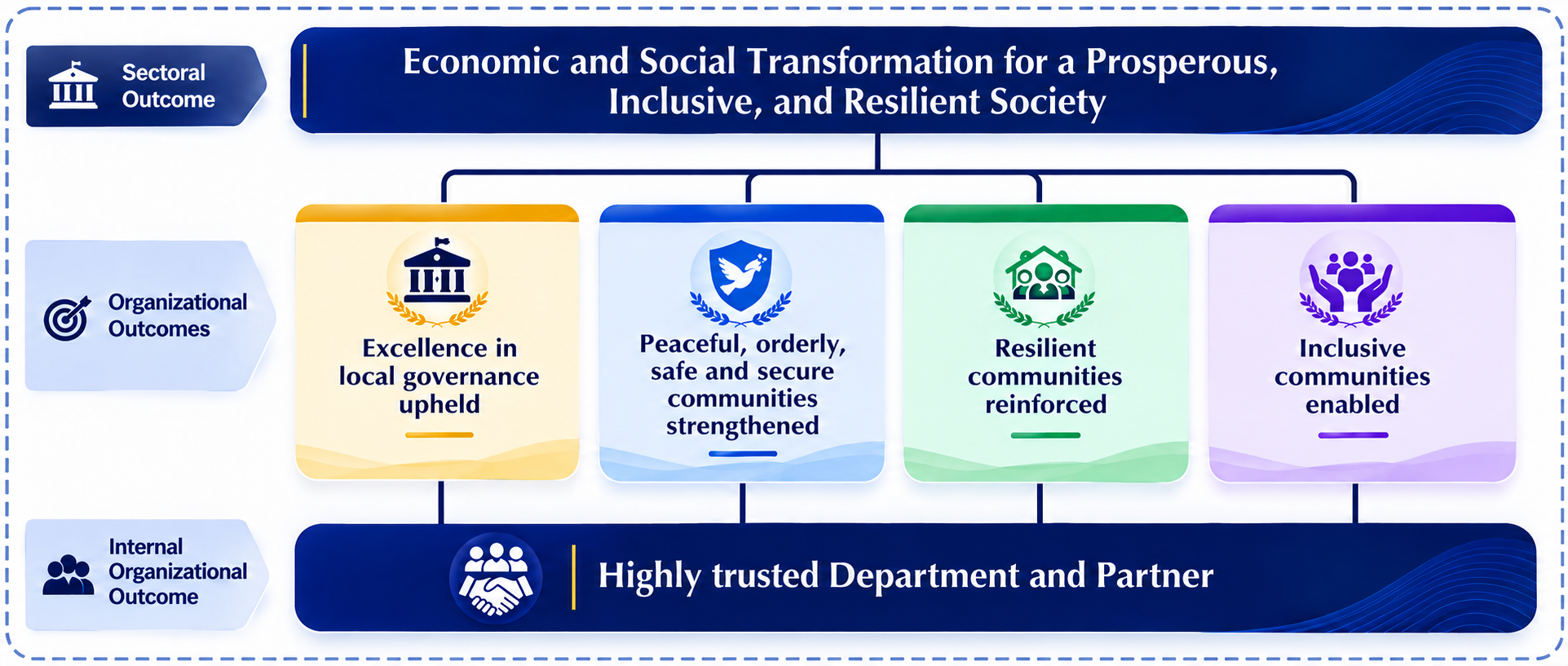
The DILG Results Framework illustrates the Department’s alignment with the PDP and its desired outcomes in accordance with the DILG Vision. Underneath each outcome are specific strategic goals that aim to develop and implement specific sectoral and cross-sectoral concerns to achieve the outcomes.
This is to ensure that all interventions of the Department will produce meaningful results and enable the organization to significantly contribute to the medium- and long-term development agenda of the government.

Societal Outcome
"Economic and social transformation for a prosperous, inclusive, and resilient society"
– Philippine Development Plan 2023–2028
The government aims to reinvigorate job creation and accelerate poverty reduction by steering the Philippine economy back to its high-growth trajectory and effect economic and social transformation for a prosperous, inclusive, and resilient society.
This national vision is carried forward at the provincial level through DILG Ilocos Sur's own localized roadmap — Talaytayan — presented below.
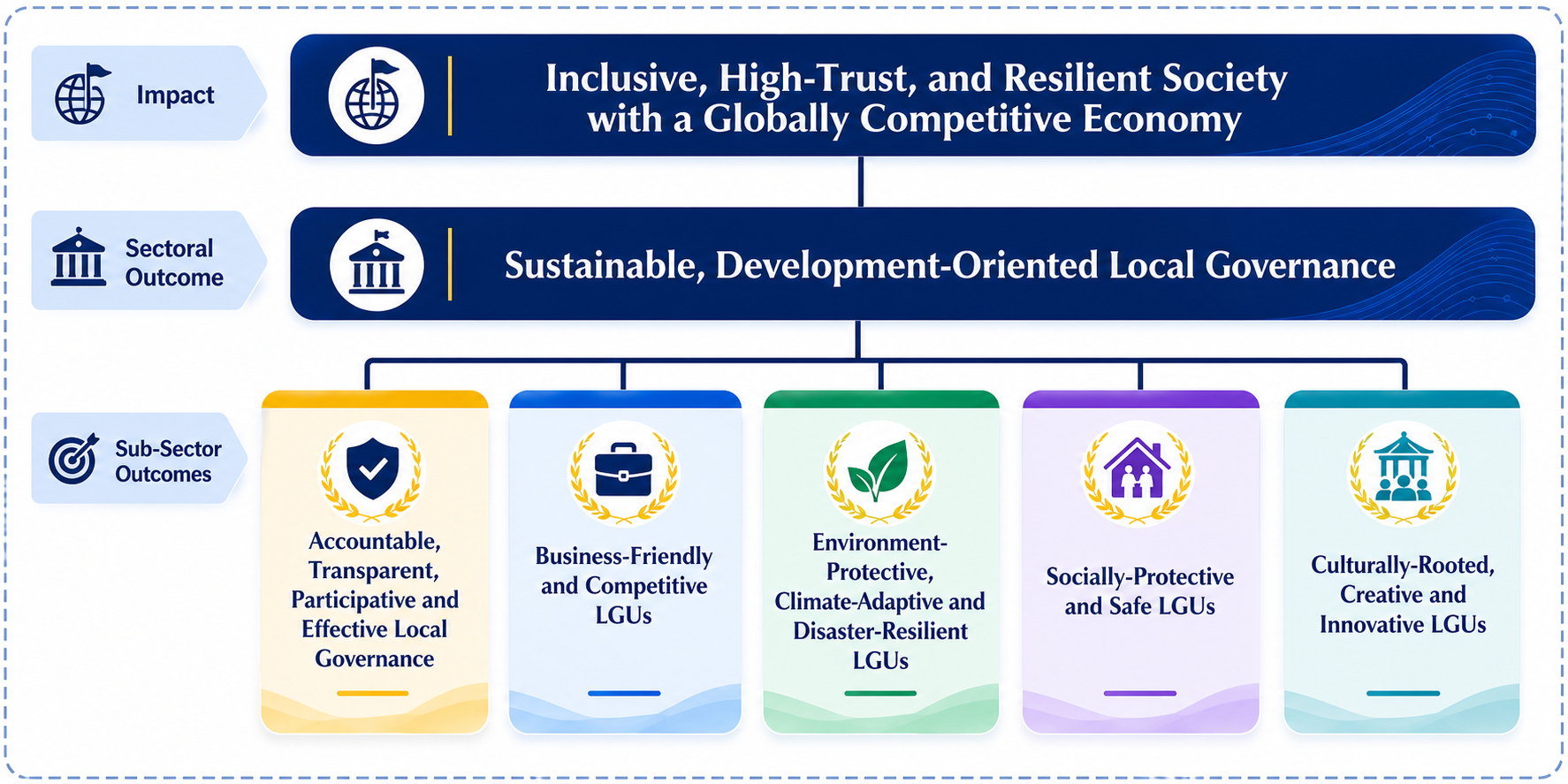
Talaytayan, an Ilocano word for “bridge,” is DILG Ilocos Sur's own results framework — the provincial translation of the National DILG Results Framework into a roadmap fit for the cities and municipalities of Ilocos Sur. It carries the same commitment to excellence in local governance, but grounds it in the priorities, partnerships, and culture of the province.
Talaytayan: DILG Ilocos Sur Roadmap 2025 and Beyond maps out how the Provincial Office's day-to-day work builds upward toward one shared destination — from strengthening its own people and systems, to delivering DILG programs more effectively, to advancing the sub-sector outcomes that define good governance on the ground.

Impact Statement
"An inclusive, high-trust, and resilient society with a globally competitive economy"
– Talaytayan: DILG Ilocos Sur Roadmap 2025 and Beyond
This is the same national aspiration anchored in the Philippine Development Plan 2023–2028 — proof that Ilocos Sur's local governance agenda moves in step with the country's long-term development goals, and that the Sectoral Outcome of a sustainable, development-oriented local governance is pursued consistently from the national office down to every barangay in the province.
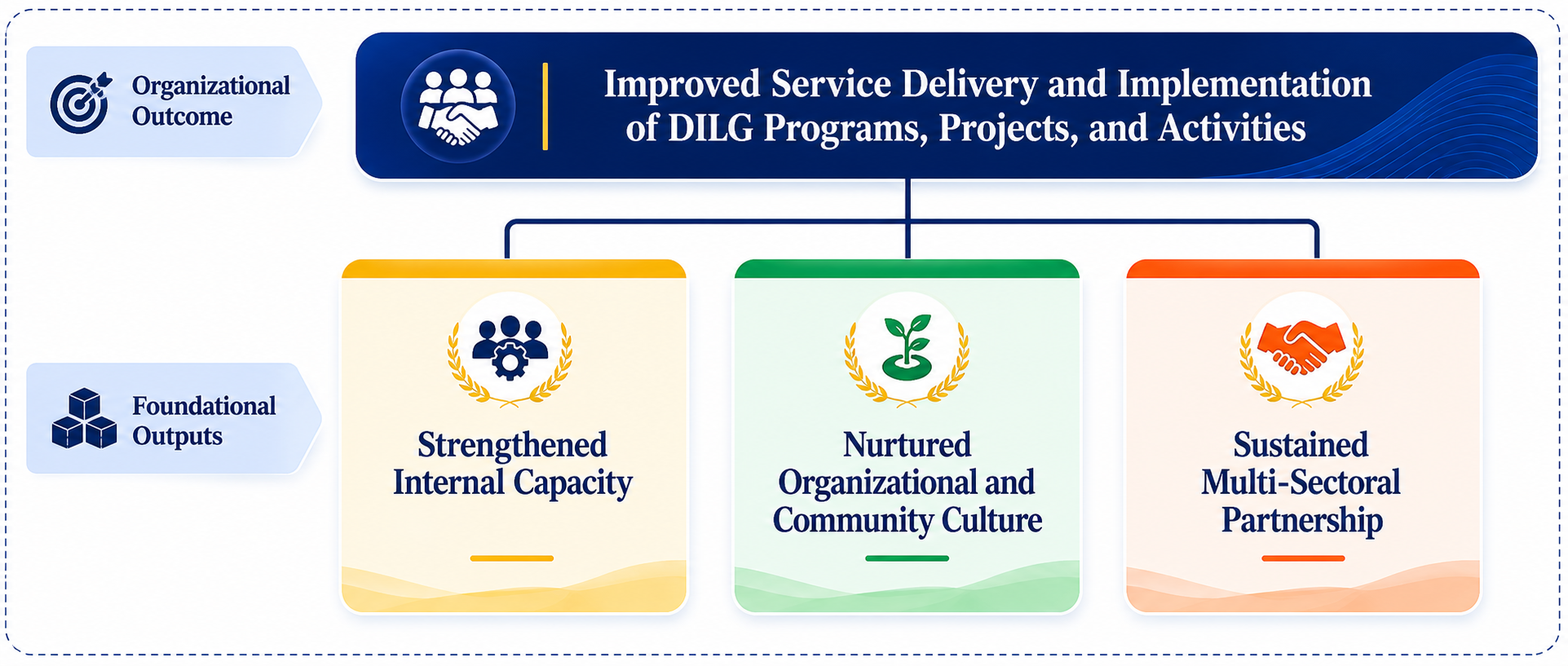
To help move the province toward this shared future, DILG Ilocos Sur's Organizational Outcome is an improved delivery and implementation of the Department's programs, projects, and activities (PPAs) — built on three foundational outputs that keep the organization capable, connected, and community-rooted.

A strengthened internal capacity equips DILG Ilocos Sur's personnel and systems to serve well; a nurtured organizational and community culture builds the trust and shared purpose that unite the Department with the communities it serves; and a sustained multi-sectoral partnership keeps local government units, civil society, and other stakeholders working together toward Talaytayan's goals.
Together, these foundations form the bridge — Talaytayan — that connects everyday provincial action to the Department's national vision of a prosperous, inclusive, and resilient Philippines.